
The Complete Guide to Living in Tanglewood, Cypress, CA
A local guide to Tanglewood, Cypress, CA; covering HOAs, home prices, schools, and amenities.
TL;DR: TL;DR: Tanglewood is a collection of established Cypress townhome communities built by Larwin in the 1960s. It’s known for mature greenbelts, community pools, and a central location near freeways, schools, and shopping. Homes are attached townhomes ranging roughly 2–4 bedrooms, with sales spanning the mid-$600Ks to $900Ks depending on size and upgrades. Tanglewood is actually made up of a few neighboring associations (Cypress Home Owners Association, Cypress Tanglewood, Tanglewood West, and Tanglewood North), so it’s worth knowing which one governs a specific property before you buy.
Living in Tanglewood, Cypress, CA
If you’re considering buying a home in Cypress, CA, Tanglewood is one of the city’s most established and recognizable residential communities. Known for its mature trees, expansive greenbelts, community pools, attached townhomes, private patios, and convenient location, Tanglewood offers a style of living that can be difficult to find in newer developments.
What “Tanglewood” Actually Means
What many buyers don’t initially realize is that “Tanglewood” is actually made up of several neighboring planned communities developed by Larwin beginning in the 1960s. Although they share similar architecture and a connected neighborhood feel, the individual communities have separate homeowners associations, amenities, rules, and financial structures.
That’s an important distinction if you’re considering buying here.
I’ve served in Cypress and North Orange County as a REALTOR® since 2009. In that time, Tanglewood has appealed to many different types of buyers.
- First-time homeowners appreciate the opportunity to get into Cypress at a price that may be below many detached single-family homes.
- Families are attracted to the location and schools.
- Downsizers appreciate the manageable size and community amenities.
- And buyers of all ages are often surprised by just how much green space exists throughout these established developments.
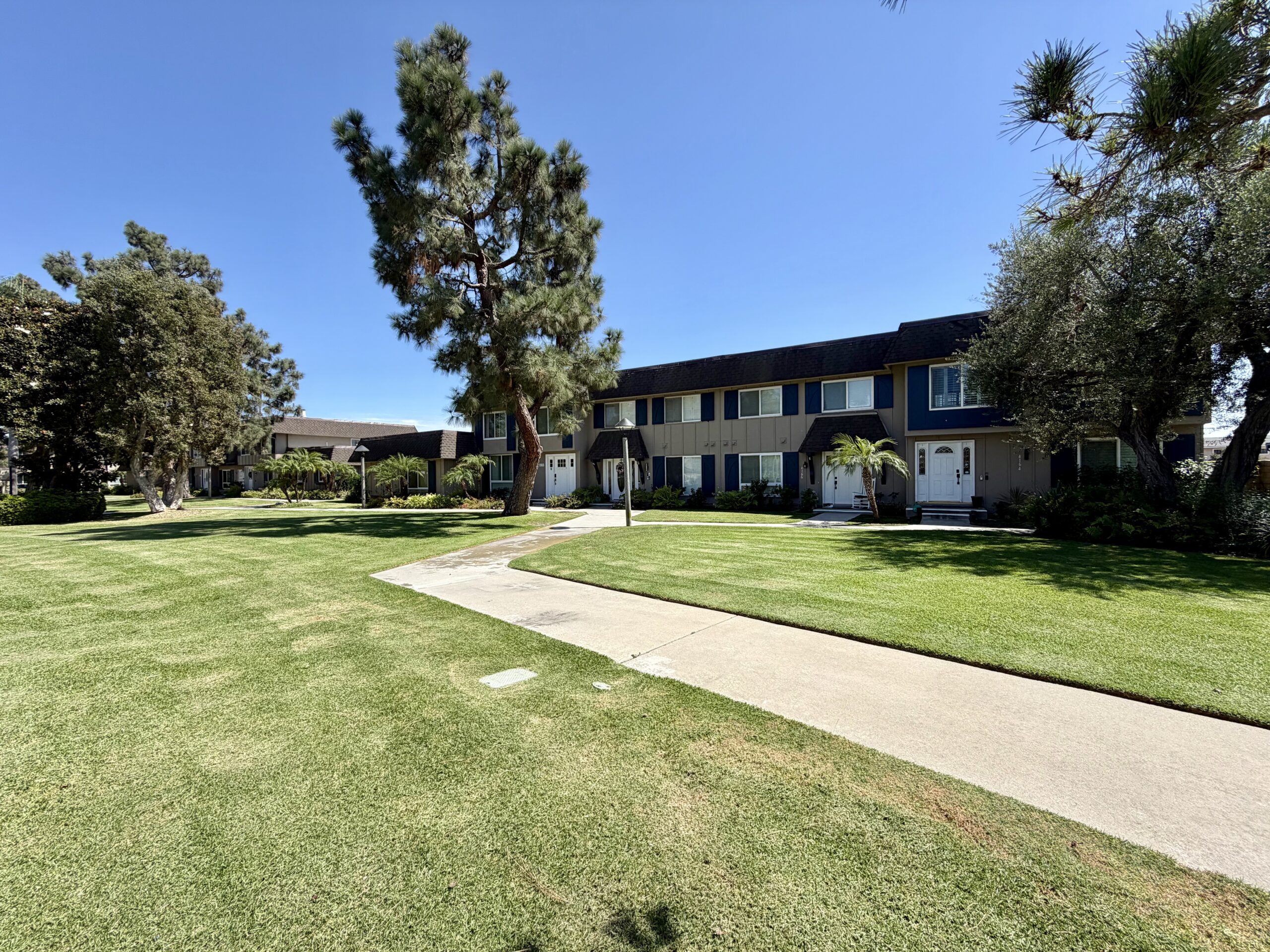
This guide covers what you should know about living in the greater Tanglewood area of Cypress — the different HOAs, floor plans, schools, amenities, home values, shopping, recreation, and commuting. It also covers remodeling potential, insurance considerations, and the small details that can make one Tanglewood location very different from another.
Location
Where Is Tanglewood in Cypress?
Tanglewood is located in the western portion of Cypress in northwest Orange County, with the various Tanglewood communities concentrated around Larwin Avenue, Denni Street, Ball Road, Via Largo, Paseo de Oro, Via Encinas, and the surrounding residential streets.
One of Tanglewood’s biggest advantages is its central location.
Residents have convenient access to Cypress, Los Alamitos, Rossmoor, Seal Beach, Long Beach, La Palma, Cerritos, Buena Park, Garden Grove, and Anaheim. Major freeways nearby include the 605, 405, 22, and 91. That makes Tanglewood particularly interesting for buyers who may work in one city but want flexibility to commute throughout Orange and Los Angeles counties.
The community is also close to everyday shopping, restaurants, parks, schools, Cypress College, and major retail along Katella Avenue, Valley View Street, Lincoln Avenue, and Los Alamitos.
Tanglewood’s history is one of the things that makes the neighborhood interesting.
During the 1960s, at a time when Cypress was transitioning from its agricultural roots into the suburban city we know today, the Larwin Company began developing planned communities in Cypress.
The original developments were considered innovative for their time because they combined private residences with shared recreational facilities and extensive landscaped open space.
Rather than designing streets lined entirely with individual front yards, the developers incorporated greenbelts, swimming pools, clubhouses, playground areas, pedestrian paths, and other common spaces. The result is a neighborhood that feels distinctly different from many conventional subdivisions built during the same period.
More than half a century later, the mature landscaping may actually be one of Tanglewood’s greatest assets. Large trees and established greenbelts give portions of the community a park-like character that would take decades to recreate in a new development.

Tanglewood HOAs: One Neighborhood, Several Communities
This is one of the most important things prospective buyers should understand.
The broader Tanglewood area consists of multiple neighboring homeowners associations developed in phases by Larwin.
These include:
- Cypress Home Owners Association – The earliest phase, developed in the mid-1960s.
- Cypress Tanglewood Homeowners Association – Developed in 1966 on approximately 35 acres and consisting of approximately 302 townhomes.
- Tanglewood West Homeowners Association – Another neighboring Larwin development with its own HOA and governing documents.
- Tanglewood North Homeowners Association – Completed in the late 1960s and the largest of the Tanglewood developments, with approximately 443 homes.
Although these neighborhoods can look and feel connected, purchasing in one HOA is not necessarily the same as purchasing in another.
Monthly assessments, insurance coverage, maintenance responsibilities, pools, clubhouses, architectural rules, parking policies, reserves, and other regulations can differ.
That’s why buyers should identify the exact association governing a property before comparing HOA dues or amenities.
Understanding the Tanglewood HOA Before Buying
With communities approaching 60 years old, reviewing the HOA documents is especially important. During escrow, buyers should carefully examine the association’s budget, reserve study, financial statements, and insurance policy. CC&Rs, rules, recent meeting minutes, and any planned projects or assessments deserve the same attention.
Pay particular attention to responsibility for roofs, exterior paint, plumbing, windows, patios, fencing, termite repairs, landscaping, and structural components.
Insurance
Insurance also deserves more attention today than it did years ago. Before purchasing, buyers should obtain the HOA’s master insurance information and determine exactly where the association’s coverage ends and the homeowner’s responsibility begins.
An insurance professional can then recommend appropriate individual coverage. Questions should include coverage for interior improvements, personal property, liability, water damage, loss assessments, deductibles, and earthquake coverage.
Because each Tanglewood association is separate, never assume that insurance coverage for one association applies to another. Verify everything for the exact property you’re considering.
Floor Plans & Square Footage
Tanglewood Homes: Floor Plans & Square Footage
Tanglewood consists primarily of attached townhomes constructed during the 1960s, with a surprisingly wide variety of floor plans.
Depending on the development and model, buyers can find homes ranging from smaller two-bedroom residences to larger three- and four-bedroom layouts.
Some of the larger models offer approximately 1,500 to more than 1,700 square feet, while smaller single-level layouts can be considerably more compact.
Many homes have two-car garages, private patios, interior laundry or garage laundry areas, and living spaces that open toward either private outdoor areas or the community greenbelts. Because these homes have been individually owned for decades, condition varies dramatically.
One property may retain much of its original floor plan and finishes. The home next door might be extensively remodeled instead, with an open kitchen, quartz countertops, new cabinetry, updated flooring, remodeled bathrooms, and a redesigned patio.
For buyers, that variety creates opportunities at different price points.
Pools & Clubhouses
Amenities vary depending upon the specific Tanglewood association, which is another reason buyers shouldn’t assume every Tanglewood property includes exactly the same features.
Across the communities, amenities can include swimming pools, clubhouses, landscaped greenbelts, pedestrian areas, and recreational facilities.
Tanglewood North, for example, was designed with multiple swimming pools located throughout the development and has two clubhouses available for resident use.
Other associations have their own amenities and rules.
- Which HOA governs the property
- Current monthly assessment
- What the assessment includes
- Number and location of pools
- Clubhouse availability
- Common-area maintenance
- Exterior maintenance responsibilities
- HOA insurance coverage
- Parking and guest parking rules
- Pet policies
- Rental restrictions
- Architectural requirements
- Current reserve funding
- Planned projects or assessments
The lowest HOA payment isn’t automatically the best HOA. What matters is what you’re receiving for the assessment and the financial condition of the association.
Greenbelts and the Park-Like Setting
If there is one physical characteristic that defines Tanglewood, it is probably the green space. The communities were designed around extensive common greenbelts rather than simply maximizing the number of homes that could fit onto the property.
Mature trees, lawns, pathways, pools, and landscaped common areas run throughout different portions of the neighborhood. For residents, these areas effectively become an extension of their living environment.
You’ll commonly see people walking dogs, taking an evening walk, heading to the pool, or simply enjoying the open space. Location within the community matters, however. Some homes have particularly attractive greenbelt settings, while others are closer to streets, parking areas, pools, or other activity.
When I’m evaluating a Tanglewood property, I wouldn’t look at the floor plan alone. The home’s position within the community can be an important part of its desirability and future resale value.
Tanglewood Prices & Values
Home Prices and Values
Tanglewood can provide an interesting value proposition within Cypress. Recent sales demonstrate how much prices can vary based on floor plan, size, upgrades, HOA, and location within the community. Smaller two-bedroom properties can trade substantially below larger remodeled three- and four-bedroom homes, while premium remodeled properties with desirable greenbelt locations can command considerably more.
During 2026, sales throughout the broader Tanglewood communities have ranged from the mid-$600,000s for some smaller homes into the $800,000s and $900,000s for larger or extensively remodeled residences.
Rather than relying on a single “Tanglewood average,” I recommend comparing a property against homes from the same association and, whenever possible, the same or similar floor plan.
That’s particularly important here because comparing a smaller two-bedroom model with a remodeled four-bedroom home can create a misleading picture of value.
Home Appreciation Over Time
One of Tanglewood’s most remarkable stories is simply how much the Orange County housing market has changed.
Homes that originally sold for roughly $20,000 in portions of the community during the 1960s are now worth many times their original prices.
Of course, past appreciation never guarantees future appreciation.
Several factors continue to support demand for Tanglewood: limited housing supply, its Cypress location, established schools, and community amenities like green space. Pricing that stays attractive relative to nearby detached homes helps too.
Condition also matters. Thoughtfully remodeled homes can attract buyers who love the established community but don’t necessarily want a 1960s interior.
Daily Life
Schools, parks, and a walk that doesn’t follow traffic.
Schools
Location plays a big role in the Tanglewood school story, since buyers need to pay attention to the specific property.
Because the Tanglewood communities cover a sizable area, school assignments should never be assumed simply because a property has a Cypress address.
Depending on location, properties may be served by different school districts and campuses. Some portions of Cypress Tanglewood, for example, are associated with Cypress schools while other portions are associated with Los Alamitos schools.
Other Tanglewood-area properties may be associated with schools such as Landell Elementary, Lexington Junior High, and Cypress High School.
Buyers also frequently ask about Oxford Academy. Admission to Oxford Academy is not simply based upon purchasing a particular house, so families interested in the school should research the current admissions requirements directly.
Because boundaries and policies can change, always verify school assignment directly with the appropriate district before purchasing.
Parks Nearby
Tanglewood residents already have significant green space inside their communities, but several public parks are also nearby.
Veterans Park is tucked into the surrounding residential area and provides additional open space close to portions of Tanglewood.
Mackay Park on Walker Street offers another neighborhood park option, while larger Cypress parks provide playgrounds, sports facilities, picnic areas, walking and jogging opportunities, and community recreation.
Oak Knoll Park is one of the city’s larger recreation areas and includes athletic fields, basketball, volleyball, playgrounds, picnic facilities, and a jogging/exercise area.
Combined with the internal greenbelts and pools, residents have plenty of options for enjoying the outdoors without traveling far from home.
Walking Trails
One of the things that doesn’t necessarily show up in an MLS description is how pleasant parts of Tanglewood can be to walk.
The mature landscaping and internal greenbelts create a completely different experience from walking alongside a major street.
For homeowners with dogs, people who enjoy morning or evening walks, and families who appreciate having open space nearby, this can be a significant lifestyle benefit.
It’s also worth walking through the community before buying rather than simply driving to the property.
A five- or ten-minute walk can tell you a lot about the home’s proximity to pools, greenbelts, parking, neighboring streets, and common areas.
Errands & pleasure without the drive.
Another advantage of Tanglewood is that you don’t have to travel far for everyday errands. Ball Road, Valley View Street, Walker Street, Katella Avenue, and nearby Los Alamitos offer grocery stores, restaurants, coffee shops, fitness facilities, pharmacies, and other services.
Costco and Trader Joe’s are both nearby on Katella Avenue, while neighborhood shopping centers along Ball Road provide convenient options for groceries, dining, and everyday services.
There are also numerous independent restaurants throughout Cypress and neighboring Los Alamitos, ranging from Mexican and Italian to Asian cuisine, coffee shops, casual dining, and takeout.
The location makes it relatively easy to run errands locally while also putting residents within a short drive of the much larger dining and entertainment options in Long Beach, Seal Beach, Huntington Beach, Cerritos, and Anaheim.
Four freeways, one neighborhood.
Tanglewood’s location in northwest Orange County gives residents access to both Orange County and Los Angeles County employment centers.
The 605, 405, 22, and 91 freeways are all accessible from Cypress. That makes commuting toward Long Beach, Cerritos, Anaheim, Los Angeles, Huntington Beach, and Fountain Valley realistic.
Long Beach Airport is particularly convenient compared with many parts of Orange County.
John Wayne Airport and LAX provide additional options for travelers.
As anyone who lives in Southern California knows, actual commute times depend heavily on traffic, so I recommend testing your anticipated commute during the hours you would actually be driving.
One area where Tanglewood homes can really shine.
Original homes were built decades ago, but many floor plans adapt very well to contemporary design.
Some of the most effective improvements I’ve seen include:
- Opening or modernizing kitchens
- Shaker-style cabinetry
- Quartz countertops
- Updated flooring
- Recessed lighting
- Modern stair railings
- Remodeled primary and secondary bathrooms
- Dual-pane windows and doors
- Updated HVAC
- Improved electrical systems
- Built-in storage
- Finished and organized garages
- Updated private patios
Private patios are especially important. Done correctly, the patio can function almost like an additional outdoor room for dining, entertaining, gardening, or relaxing.
Before making exterior modifications, however, homeowners should confirm HOA architectural requirements and obtain approval when necessary.
Did You Know?
Things Buyers May Not Know About Tanglewood
One of the most important things to understand is that two homes that look nearly identical online can offer very different living experiences. A unit might face a beautiful greenbelt while another sits closer to a street or parking area. Guest parking can also be easier to reach from some units than others.
Another may be conveniently located near a pool, which could be a major positive for one buyer and something another buyer would prefer to be farther away from.
End units, patio orientation, garage location, sun exposure, proximity to greenbelts, and the amount of pedestrian traffic around the property can all affect how a home feels.
That’s why I strongly recommend walking the immediate area around any Tanglewood property you’re considering. Don’t just tour the inside of the home.
Potential Advantages
Tanglewood offers mature landscaping, extensive green space, pools and other community amenities, multiple floor plans, private patios, convenient access to shopping and freeways, established schools nearby, and a Cypress location that can provide strong value compared with some surrounding detached-home neighborhoods. The age of the community also gives it character that many newer developments simply haven’t had enough time to develop.
Things to Consider
These are older homes, so buyers should pay close attention to plumbing, electrical systems, HVAC, windows, roofs, drainage, termite conditions, and previous remodeling. There is also an HOA, and each association has its own financial condition, rules, assessments, and maintenance responsibilities. Buyers wanting a large private yard, complete control over exterior modifications, or no HOA may prefer a traditional detached home.
Tanglewood Cypress, answered directly.
Tanglewood can be an excellent option for buyers who want to live in Cypress. It suits those who value green space, community amenities, an established neighborhood, and a more manageable home and outdoor area. It works particularly well for first-time buyers, families, professionals, and downsizers. Homeowners who appreciate pools and landscaped common areas, without personally maintaining that space, tend to be a good fit too.
But choosing the right Tanglewood home involves more than finding the right number of bedrooms. You should compare the individual HOA, floor plan, location within the community, condition, upgrades, parking, schools, insurance, and recent comparable sales.
That’s ultimately what makes Tanglewood interesting: there is a surprising amount of variety within what initially appears to be one neighborhood.
If you’re considering buying or selling a home in Tanglewood, I’d be happy to help you compare the different communities, understand recent sales, review the individual locations, and determine which properties best fit your goals.
No. The greater Tanglewood area includes multiple neighboring planned communities with separate homeowners associations. Buyers should determine the exact HOA for any property they are considering.
Larwin developments were constructed primarily during the 1960s, with different phases completed at different times.
The communities primarily consist of attached residences commonly marketed as townhomes, although legal ownership and property classifications should always be verified for the specific property.
Yes. Community swimming pools are an important feature of the Tanglewood developments, although the number of pools and access depends upon the individual association.
Many of the later Tanglewood homes include garages, while the earliest Larwin phase included carports. Always verify parking for the individual property.
HOA dues vary by association and can change annually. Buyers should verify the current assessment directly from the association and review exactly what the payment includes.
School assignments vary depending upon the property’s location. Buyers should verify current boundaries directly with the applicable school district.
Yes. Many Tanglewood homes have been extensively remodeled. Exterior modifications and certain improvements may require HOA approval.
They can be. Tanglewood may offer buyers an opportunity to own in Cypress at a lower price than many nearby detached single-family homes while still enjoying community amenities and a desirable location.
In addition to the normal home inspection and disclosures, carefully review the specific HOA’s financial statements, reserve study, insurance, CC&Rs, rules, meeting minutes, assessments, maintenance responsibilities, and any planned major projects.
Condition and floor plan matter, but location within the community can be equally important. Greenbelt views, privacy, end-unit positioning, patio orientation, parking, proximity to pools, and overall setting can all influence desirability and resale value.
Values vary significantly based on the specific association, floor plan, size, upgrades, condition, and location. The best way to determine value is to compare recent sales of similar models within the same portion of Tanglewood rather than relying solely on citywide averages or automated online estimates.
Buying or Selling in Tanglewood, Cypress, CA
I’ve worked Tanglewood, Cypress, CA and the surrounding North Orange County communities since 2009. If you’re weighing a purchase, thinking about selling, or just want to know what a specific unit is really worth, let’s talk it through.